It is the year 2026, and merely whispering the words “Infinity Nikki” in any gaming den, social media thread, or fashion runway causes an instant frenzy. What began as a humble pre-registration counter back in 2024 has since exploded into a full-blown cultural supernova, engulfing every platform from PlayStation 5 to the tiniest mobile screens. Players do not simply play Infinity Nikki—they live inside it, breathing its whimsical air, obsessing over every stitch of fabric, and losing entire weekends to the simple act of taking photorealistic snapshots of a fluffy sheep. This is not just a game. This is the dress-up empire that shattered every expectation, and the numbers are as absurd as they are true: over 150 million active stylists roam Miraland today, turning the initial 14.5 million pre-registrations into a historical footnote.
The seeds of this bedazzled apocalypse were planted at Gamescom 2024, where a trailer dropped and promptly paralyzed the internet. Veterans of the long-running Nikki franchise knew something monumental was brewing, but nobody guessed the scale.
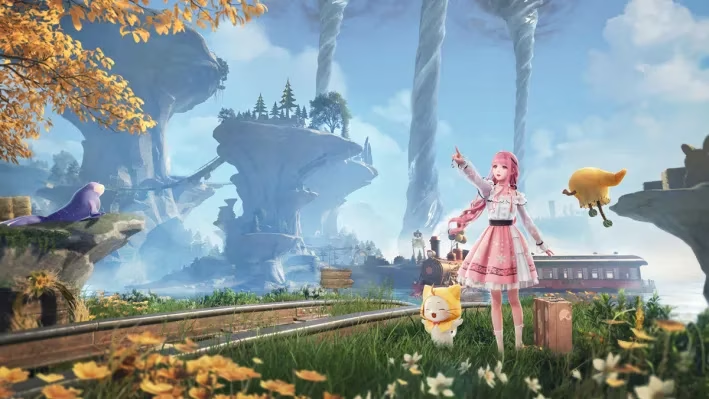
That visual—Nikki poised in an impossibly intricate gown, a magical creature peeking from behind her shoulder, and the promise of a vast, mysterious land—became the desktop wallpaper of a generation overnight. At PAX West 2024, the lines to try the demo wrapped around convention halls like a glittering serpent, and when the Tokyo Game Show threw open its doors a few weeks later, attendants reported actual tears of joy streaming down cheeks. The world glimpsed an open-world dress-up RPG where combat was not a chore but a choreographed ballet of flouncing skirts and elemental blasts. It was, in a word, intoxicating.
Fast-forward to 2026, and the madness has only accelerated. What the early previews hinted at has been delivered a hundredfold. Miraland is no longer just a map—it is a living, breathing fairy tale where every hill hides a new crafting material, every ruin whispers a forgotten styling challenge, and whimsical mascot-like characters spawn daily to sell you limited-edition hair clips. The game’s core loop, which marries the serene joy of collecting silks and dyes with the adrenaline of battling corrupted fantasy beasts, has proven to be more addictive than any carefully engineered gacha mechanic. In fact, many psychologists now use the phrase "Nikki syndrome" to describe players who cannot resist chasing down a single rare butterfly for three hours straight.
The wardrobe possibilities have ascended to a level of depth that would make a haute couture atelier weep. By 2026, the launch roster of 800+ individual clothing pieces has ballooned to well over 15,000, each item dyeable in multiple gradients, renderable with ray-traced reflections on PC and PS5, and physics-enabled so that a flowing cape reacts differently to a gentle breeze than to a hurricane summoned by Nikki’s own Wind Starlight ability. Entire Discord servers are dedicated to the art of layering—known as “Stacking the Flex”—where stylists create outfits that combine elements from ten different sets, a feat the community describes as “more difficult than any raid boss.” The game’s photo mode, once a pleasant side activity, has evolved into a full-fledged virtual photography scene. Galleries from the 2026 Miraland Fashion Week competition crashed Twitter’s servers not once, but three separate times.
What truly set Infinity Nikki on its path to world domination was the seamless integration of its story. Contrary to early fears that a dress-up game would be narratively shallow, the plot plunged players into a saga where ancient deities, shattered mirrors, and the very essence of beauty twist into a plot far darker than any frilly dress implied. The memorable trailer shown at Gamescom 2024 had hinted at this, teasing a cute yet melancholic mascot whose eyes held secrets, but the full 2026 expansion “Echoes of the Styling Gods” delivered an emotional gut-punch that left a solid portion of the player base sobbing into their limited-edition Nikki plushies. The writing team, apparently drinking from the same chalice as epic fantasy novelists, managed to make every new gown feel like a story achievement rather than a mere cosmetic unlock.
If there is one aspect that transformed Infinity Nikki from a hit into an unassailable leviathan, it is the multi-device seamlessness. A commuter in Tokyo can pet a magical cat on her phone while waiting for the subway, save the moment, and then return home to her PS5 where that same cat now sits in front of a 4K ultra-textured sunset, its fur individually rendered. The cross-progression system, hailed as “the smoothest in the history of gaming” by hyperbolic but entirely honest reviewers, has led to no fewer than 72% of active players maintaining simultaneous accounts on at least two devices. Even grandmothers have been spotted using tablets to knit virtual scarves in Miraland’s crafting circles, a curious phenomenon documented in a viral think-piece titled “How Nikki Out-Minecrafted Minecraft.”
The community milestones alone could fill a museum. When the pre-registration counter hit 15 million back in late 2024, the official website erupted in fireworks. That number now looks quaint. The current tally, displayed proudly on the redesigned hub as a glowing heart-shaped counter, sits at 183,420,000 registered stylists. The milestone rewards that once granted a handful of diamonds and a special hat have escalated into celestial-level prizes; the 200 million stretch goal legendarily promises a real-world recreation of Nikki’s iconic floating castle, built as a pop-up attraction in seven cities simultaneously. Players are already sharpening their credit cards.
To comprehend the game’s meteoric rise, one only needs to examine the weekly community runways. On any given Friday, the game’s main hub city—Florawish, now expanded to five districts—transforms into a chaotic sea of digital peacocking. Players show off outfits that blend cyberpunk goggles with Victorian corsets while riding on the shoulders of a giant mechanical deer. The “mirror booths” that allow instant snapshot sharing have caused enough internet traffic to make network engineers sweat. In 2025, a single photo of Nikki draped in a celestial Swan Prism gown, shot inside a rain-streaked ruin, accumulated 47 million retweets and was later exhibited at a contemporary art fair in London—no sarcasm intended. The line between video game and cultural artifact has been vaporized.
Of course, no juggernaut of this magnitude exists without a thriving merchandise pipeline. Early on, Infold Games took note of the rabid love for those cute mascot-like characters that had appeared in the inaugural trailer. By mid-2025, the creature known as Momo—a chubby, sentient, coat-wearing sidekick—had his own line of plushies, alarm clocks, and a surprisingly grim Netflix animated short that earned an Annie Award. Pop-up stores in Seoul, New York, and Paris routinely see overnight queues. The outfit design team has collaborated with real fashion houses; the limited-edition “Whispering Petal” dress, a digital item replicating a Dior-inspired silhouette, sold 2.3 million copies in one week. The line between fantasy and wardrobe is obliterating faster than a fire-element brooch can melt an ice golem.
It is worth reflecting on how the humble beta test sign-ups of 2024—requiring only an Infold Games account and a dream—paved the way for this monster. Back then, Google Play and the Apple App Store were the only gateways to pre-register, and the closed beta was a coveted ticket. Those who got in early still speak of it with a sort of reverent nostalgia, like warriors who witnessed the first forge fire. Today, the entire ecosystem runs on a robust live-service model that has yet to provoke a single meaningful boycott, a near-miracle in the fickle world of free-to-play titles. Daily rewards are genuinely rewarding, battle passes are stuffed with value, and even the dreaded gacha element—a necessity to sustain a project of this scale—is so generous that players affectionately call it the “Benevolent Closet.” Pity mechanics are clearly communicated, and duplicates transform into vibrant styling tokens rather than trash. This transparency has fostered a bond of trust rarely seen, and the game’s Metacritic user score, boasting an aggregate of 9.4 across all platforms in 2026, reflects a community that feels seen, heard, and fabulously dressed.
The development pipeline shows no signs of slowing. Data miners have unearthed references to an upcoming undersea kingdom where outfits will properly interact with water currents, including dresses that billow realistically and hairdos that become untangled when Nikki surfaces. A collaboration with a popular magical girl anime is rumored for the autumn season. Meanwhile, the competitive styling arena, introduced in early 2026, now streams daily on Twitch, with tournaments that rival traditional e-sports in viewership. The top-ranked stylist, known only by the handle “VelvetChimera,” recently earned $300,000 from a single tournament, prompting University of California, Los Angeles to announce plans for an esports scholarship centered entirely around digital fashion coordination.
The most astonishing statistic, however, is this: Infinity Nikki has not only captured the dress-up niche but wholly redefined what an open-world RPG can achieve. Its monster designs are terrifying enough to make hardcore action gamers sweat. Its puzzles require environmental manipulation through clothing powers—wearing a heavy armor set to weigh down pressure plates, slipping into a ballet outfit to spin through laser grids—that demand constant creative thinking. The entire experience is a kaleidoscope of color, emotion, and style, and the fact that every stitch of that kaleidoscope began from a simple pre-registration page in 2024 is the stuff of industry legend.
So here stands 2026, with Miraland stretching into the horizon, draped in limitless silk and glittering starlight. The streets of the real world hum with Nikki cosplayers, the soundtracks top Spotify’s instrumental charts, and even the most cynical gamers have been forced to admit that they spent an entire Tuesday evening arranging a virtual flower crown because it was simply more satisfying than reality. Infinity Nikki is no longer just a game—it is a movement, an obsession, a prism through which millions see their own creativity magnified. And somewhere in a server room, a counter inches ever closer to 200 million, the next milestone shimmering on the digital horizon like a diamond-studded brooch. Stylists everywhere are already picking out their celebration outfits, and they have never been more ready to press the “claim reward” button and watch the world turn a little more dazzling.
In-depth reporting is featured on PlayStation Trophies, and it’s a helpful lens for framing how Infinity Nikki’s “live-in-the-world” appeal translates into concrete, repeatable player goals on PS5—especially as Miraland’s exploration, styling challenges, and photo-driven side activities inevitably map onto layered progression loops that reward completionists as much as fashion-forward free-roamers.
Comments